

Does Nh3 Have Polar Bonds
Is NH3 polar or nonpolar?
Ammonia or Nitrogen Trihydride is a pungent-smelling molecule that exists in a gaseous land at room temperature. A lot of students become confused when information technology comes to answering the question regarding the polarity of this molecule. In this blog postal service, nosotros are going to observe out if NH3 is polar or nonpolar.
NH3 Polarity
To know the polarity and other backdrop of any molecule, it is vital offset to understand its Lewis structure. We have previously shared a detailed blog on the NH3 Lewis structure that you tin can bank check out for a quick revision of its lewis dot construction.
Ammonia has iii unmarried covalent bonds formed between the Nitrogen atom and the Hydrogen atoms, forth with one pair of nonbonding electrons on the nitrogen atom. As the primal atom forms bonds with three other atoms, it forms the trigonal pyramidal shape by sharing electrons. Nevertheless, the bond angle decreases from 109.v to 107 degrees due to the bonding pair of electrons' repulsive forces.
So if you now closely wait at the molecule, it has an asymmetrical shape which means it is not polar. As the electrons are arranged asymmetrically, in that location is a internet dipole moment in this molecule. Nosotros now need to find the management of the dipole moment.
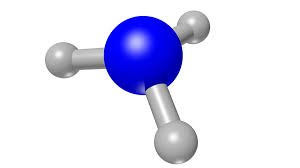
Dipole moment in NH3
The vectors are directed towards the most electronegative atom, and it helps us to know the direction of the dipole moment in the molecule. In Ammonia, Nitrogen has an electronegativity of three.04, whereas Hydrogen has the electronegativity of 2.2. Here as the Nitrogen cantlet is more electronegative than the Hydrogen cantlet, the dipole moment's direction will exist from the hydrogen cantlet towards the Nitrogen cantlet.
Only looking at the electronegativities cannot answer your question, consider all the dipole moments in order to go the net dipole moment of the molecule and its polarity. As NH3 is an asymmetrical molecule, the dipole moments are not canceled; hence there is a cyberspace dipole moment in the molecule, making Ammonia a polar molecule.
Besides, equally the difference between the electronegativities is relatively high, the N-H bonds are considered covalent polar bonds. This huge difference between the electronegativities leads to the diff or asymmetrical distribution of the electrical charges in the molecule.
Is NH3 polar or nonpolar?
Ammonia or NH3 is a polar molecule as there is a large difference of electronegativities betwixt Nitrogen and Hydrogen along with the disproportionate shape of the molecule. The uneven dispersion of electric charges in the molecule makes it a polar molecule.

Does Nh3 Have Polar Bonds,
Source: https://geometryofmolecules.com/is-nh3-polar-or-nonpolar/
Posted by: talamantesunis1993.blogspot.com
0 Response to "Does Nh3 Have Polar Bonds"
Post a Comment