

Lowest Point Of A Wave
ten.1 Wave Basics
Waves more often than not begin as a disturbance of some kind, and the energy of that disturbance gets propagated in the form of waves. We are most familiar with the kind of waves that suspension on shore, or rock a boat at sea, but at that place are many other types of waves that are important to oceanography:
- Internal waves class at the boundaries of of different densities (i.e. at a ), and propagate at depth. These mostly motility more slowly than surface waves, and can be much larger, with heights exceeding 100 m. However, the meridian of the deep wave would be unnoticeable at the surface.
- Tidal waves are due to the motility of the tides. What we think of as tides are basically enormously long waves with a that may span one-half the globe (see section 11.1). Tidal waves are not related to , so don't confuse the two.
- Tsunamis are large waves created as a outcome of earthquakes or other seismic disturbances. They are also called seismic sea waves (department ten.4).
- Splash waves are formed when something falls into the ocean and creates a splash. The giant wave in Lituya Bay that was described in the introduction to this chapter was a splash wave.
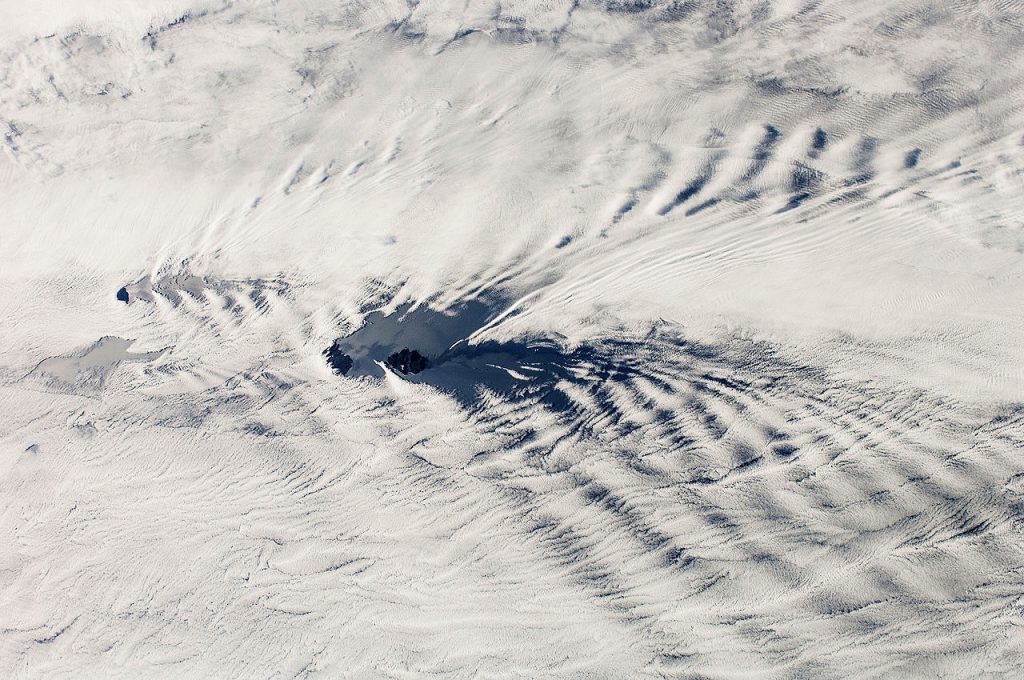
- Atmospheric waves class in the sky at the purlieus between air masses of different densities. These frequently create ripple effects in the clouds (Figure 10.i.one).
There are several components to a bones wave (Figure 10.1.2):
- Notwithstanding water level: where the water surface would be if there were no waves present and the ocean was completely calm.
- Crest: the highest point of the wave.
- Trough: the lowest point of the wave.
- Moving ridge height: the distance between the crest and the trough.
- Wavelength: the distance between two identical points on successive waves, for example crest to crest, or trough to trough.
- Wave steepness: the ratio of wave height to length (H/Fifty). If this ratio exceeds 1/seven (i.east. height exceeds i/7 of the wavelength) the wave gets too steep, and will break.
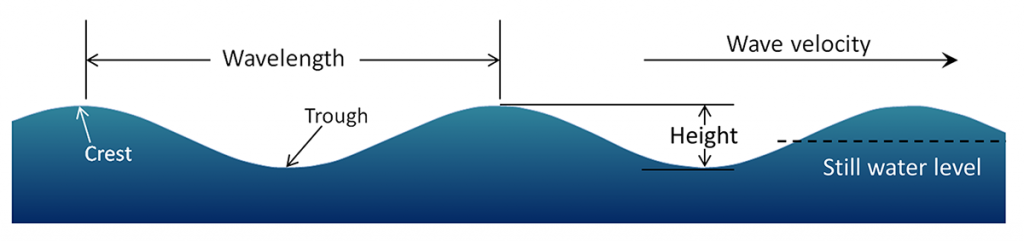
There are also a number of terms used to describe wave motility:
- Flow: the time it takes for two successive crests to pass a given point.
- Frequency: the number of waves passing a point in a given corporeality of time, usually expressed as waves per second. This is the inverse of the flow.
- Speed: how fast the moving ridge travels, or the distance traveled per unit of time. This is likewise called (c), where
c = wavelength x frequency
Therefore, the longer the , the faster the moving ridge.
Although waves can travel over great distances, the water itself shows little horizontal motion; information technology is the free energy of the moving ridge that is existence transmitted, not the water. Instead, the water particles move in round orbits, with the size of the orbit equal to the (Figure 10.i.3). This orbital motility occurs because water waves contain components of both longitudinal (side to side) and transverse (up and down) waves, leading to circular motion. As a wave passes, water moves forwards and up over the wave , then downwardly and backwards into the , so there is little horizontal movement. This is evident if you lot have always watched an object such as a seabird floating at the surface. The bird bobs up and down as the wave pass underneath it; it does not get carried horizontally by a unmarried wave crest.
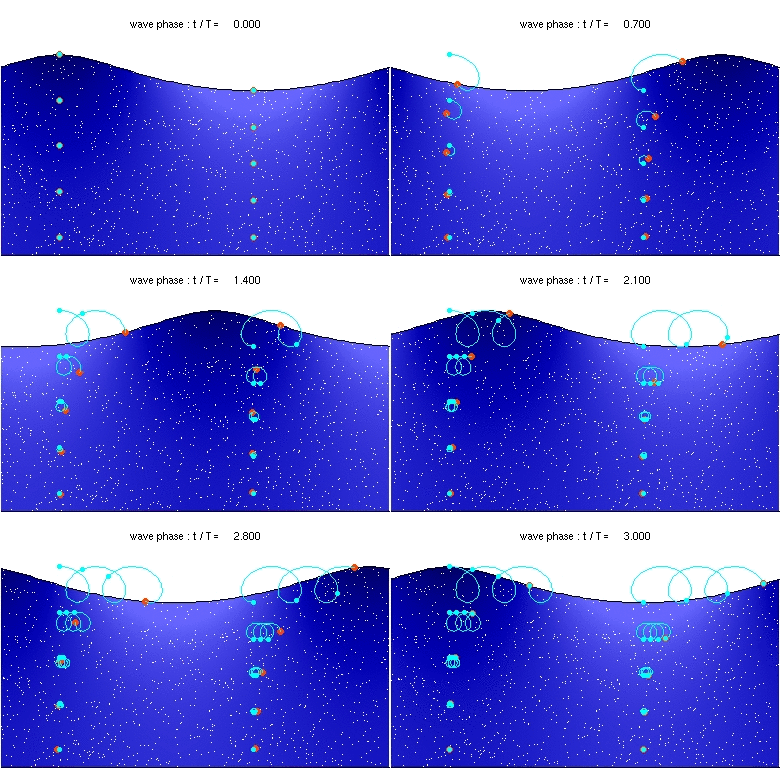
The circular orbital motion declines with depth as the moving ridge has less impact on deeper water and the diameter of the circles is reduced. Somewhen at some depth there is no more circular motion and the water is unaffected by surface moving ridge action. This depth is the and is equivalent to half of the (Effigy 10.1.4). Since most ocean waves have wavelengths of less than a few hundred meters, virtually of the deeper ocean is unaffected by surface waves, so fifty-fifty in the strongest storms marine life or submarines can avoid heavy waves by submerging beneath the wave base.
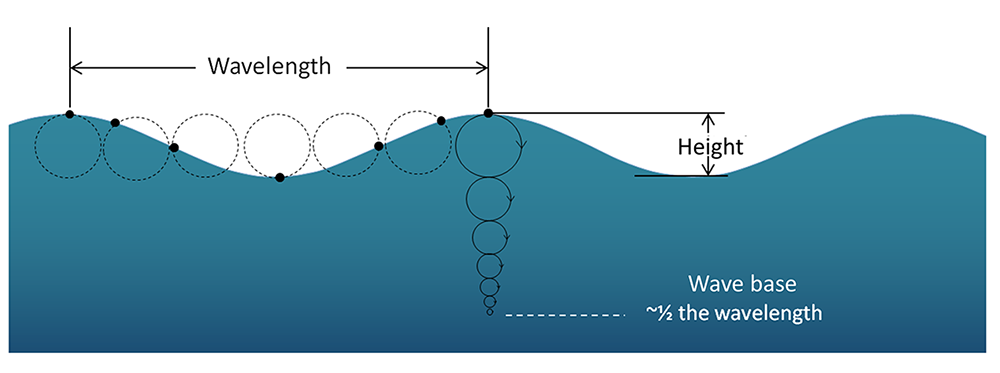
When the water below a wave is deeper than the moving ridge base (deeper than one-half of the wavelength), those waves are called . Most open ocean waves are deep water waves. Since the water is deeper than the wave base, deep water waves feel no interference from the bottom, and then their speed only depends on the wavelength:
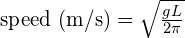
where g is gravity and Fifty is wavelength in meters. Since thou and π are constants, this tin can be simplified to:

occur when the depth is less than one/20 of the wavelength. In these cases, the wave is said to "touch on bottom" because the depth is shallower than the so the orbital motion is afflicted by the seafloor. Due to the shallow depth, the orbits are flattened, and somewhen the h2o motility becomes horizontal rather than circular just above the lesser. The speed of shallow water waves depends but on the depth:

where g is gravity and d is depth in meters. This tin be simplified to:

or transitional waves are plant in depths between ½ and i/20 of the wavelength. Their beliefs is a bit more complex, as their speed is influenced by both wavelength and depth. The speed of an intermediate moving ridge is calculated as:

which contains both depth and wavelength variables.

Lowest Point Of A Wave,
Source: https://rwu.pressbooks.pub/webboceanography/chapter/10-1-wave-basics/
Posted by: talamantesunis1993.blogspot.com
0 Response to "Lowest Point Of A Wave"
Post a Comment