

Is There A Reliable Inmate Calling Phone Service?
"You take lx more than seconds." "You have 30 more seconds."
The female voice interrupted each time Maria Marshall talked on the telephone with her son in prison house.
But the take a chance to make contact for three or four minutes a twenty-four hour period, a few days a week, came with a cost. Marshall spent $120 in simply two weeks in July for her son to call her and other relatives and friends.
"My son is but trying to get through it," Marshall said a few weeks before he was released. NBC News agreed not to publish his name, age or what he was bedevilled of because he is still in his teens. "He's afraid. He's scared. It's a traumatic experience. Talking to familiar people and his family is making that experience less traumatic."

Many states brand millions each year in commission off telephone calls that families like Marshall's struggle to pay for. Inmate calling services are controlled by two main telecommunications companies, but the Federal Communications Commission says information technology does non have authority to ready toll caps on intrastate calls, which account for a bulk of prisoner telephone calls.
Some are at present pushing for change. U.S. Sen. Tammy Duckworth, D-Ill., and five other senators have introduced a bill calling for "just and reasonable charges" for intrastate and interstate calling that would requite the FCC potency to address inmate calling rates.
"This allows the FCC to regulate and say yous can't take predatory pricing," Duckworth said. "Cause that'due south what's happening — predatory pricing."
For Marshall and her son, who was imprisoned hours abroad from her in Washington state from January to July this year, the phone calls helped her make sure he was safe.
"For his ain sanity, his own safe and my peace of mind every bit his female parent, I need to hear from him," Marshall said. "If I don't hear from him, I worry."
But some months, Marshall struggled to pay for the calls.
"These are non luxuries for a human being to be able to call their mother," she said. "Their impact is likewise on the family members."
2 companies, Securus Technologies, headquartered in Carrollton, Texas, and Global Tel Link in Falls Church building, Virginia, boss the prison telecommunications industry and have a large say in the cost of phone calls made by the one.v million men and women incarcerated nationwide.
Securus serves more 3,400 correctional facilities in the United States, and Global Tel Link over 2,400.
A typical fifteen-minute prison phone call within Washington costs around $1.65, making it i of the more affordable states for such communications. On the other end of the spectrum, such a phone call in Kentucky costs around $five.70.
Marshall has been paying these charges for 13 years, since her ex-husband was sentenced to life without parole plus six years in a Colorado prison for starting time-caste murder and aggravated motor vehicle theft.
But putting money on both her son's phone account and her ex-hubby'due south became also much, and she had to cull betwixt the two. She chose her son's.
"It's supporting my son'south humanity. Someone who's coming dorsum into the customs," Marshall said. "Humanized and connected to his family is helping brand a reentry plan."
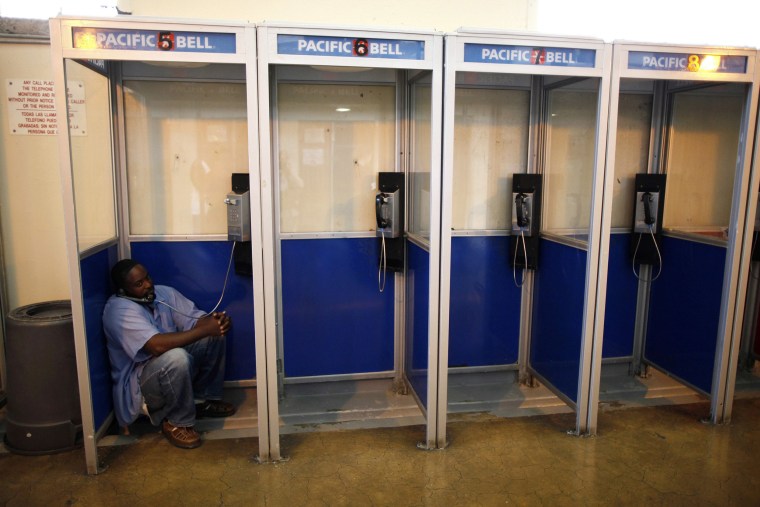
Many people in prison are aware of the high price tag associated with staying connected to loved ones, said Spencer Oberg, who was imprisoned from 2011 to 2018 and is now CEO of Unincarcerated Productions, a visitor that aims to change negative attitudes toward prisoners and erstwhile prisoners.
Because of that awareness, he said, many incarcerated people discourage their family members from putting money on their telephone accounts because they don't desire to be a financial burden.
"I couldn't even count how many people I knew personally throughout my sentence that either their family members could not beget to put money on the phones and then they could stay in touch, or the incarcerated person was not willing to put that burden on their family," Oberg said.
The FCC attempted in 2013 to set new rate caps for interstate calls. The side by side year, it tried to establish a second cap to regulate intrastate calls.
Only nether the Trump administration and FCC Chairman Ajit Pai, the agency abandoned the statement that "the Commission has the authority to cap intrastate rates for inmate calling services," in a letter to the U.S. Commune Court of Appeals for the Commune of Columbia Excursion.
The Human Rights Defense Middle and other prisoners' rights advocates argue the FCC's determination benefited inmate calling services because it allowed them to continue charging the higher rates.
They also said the decision reflected a disharmonize of involvement because one of Pai's clients at the law firm Jenner & Cake, where he worked before condign chairman, was Securus Technologies.
"The D.C. Circuit has ruled that the FCC currently lacks the authority to regulate the rates of intrastate calls from prisons," an FCC spokesperson said in a argument in July.
The FCC's decision led to the current interstate calling rates and returned the amount providers can charge equally fees to the acting caps set in 2013. The current toll of an interstate call is 21 cents a minute for debit or prepaid calls, and 25 cents a minute for collect calls. Additionally, providers can charge a $3 fee for automatic payments, $5.95 to speak to a alive amanuensis and $2 for paper bills and statements.
In the absence of regulation on intrastate calls, states may enter into contracts with prison telecommunications companies and set their own prices. In making these contracts, states tin earn a commission off the total revenue the inmate calling service collects on intrastate calls.
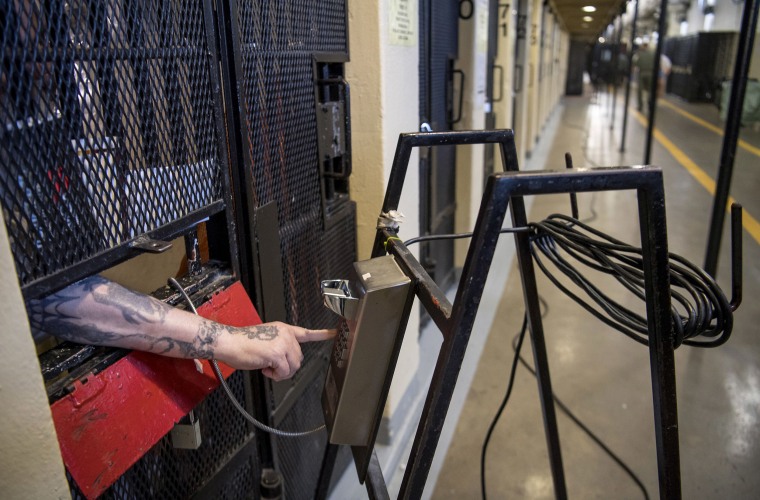
Washington state collected $three.8 one thousand thousand in commission in 2017, or 56 pct of Global Tech Link's intrastate acquirement that twelvemonth. The agreement remains in event.
Xc-two percentage of prison phone calls are intrastate, allowing states to make millions off phone calls many struggle to beget.
"Our call rates are set based on contracts with individual states and counties, and details of those contracts are more often than not dictated by competitively bid, public RFPs," Securus Technologies said in a argument, referring to asking for proposals. "Most states and counties include commissions as part of those RFPs, which can account for as much equally 90 percent of overall call rates."
"Each jurisdiction determines how they utilise acquirement from commissions, but many utilise them to help fund boosted services for incarcerated individuals, including addiction workshops and educational courses."
Global Tel Link declined to comment.
While not all states receive commissions, each contracts with a unmarried prison telecommunications company, limiting prisoners and their families to that service merely. The lack of consumer choice creates monopolies in each state, allowing the companies to charge whatever they desire, critics say.
"The ultimate consumer of the service here, which is the prisoner, has no consumer choice," said David Fathi, director of the American Ceremonious Liberties Marriage's National Prison house Project. "They tin't say, 'Wow, these telephone calls at this prison house are likewise expensive' and can't switch."
Bruce Reilly, deputy director of VOTE, a nonprofit run by formerly incarcerated people and their family members that works to help those affected by the criminal justice system, was incarcerated in Rhode Island from 1993 to 2005. He called the organisation monopolistic and immoral.
"Nobody else negotiates my grocery prices. Nobody else decides which cellular phone provider I apply or Roku or HBO," Reilly said. "That's my choice equally the user. Hither, you're incarcerated in prison, and someone else is negotiating for you."
Paul Wright, director of the Human Rights Defense Centre and editor of Prison Legal News, said the system gives prisoners no options.
"The alternative is they don't talk to their family," Wright, who was incarcerated in Washington from 1987 to 2003, said.
For David Moore, phone calls accept been his lifeline. He was 20 years old when he was sentenced to 18 years in prison for assault, a drive-by shooting and other convictions.
His son, now ten, was born when he began serving time, but through phone calls and prison visits, Moore has been able to co-parent his child.
"At that place's been times that I've had to trade away my personal hygiene — deodorant, toothbrush, lather, food, just to attempt and phone call my son," he said.
That connection to loved ones and the exterior world is a significant factor in a successful reentry into society afterward a prisoner is released, studies testify. Prisoners who had family support during their incarceration were less likely to be back in prison later on rejoining their communities.
"When people get out, they're gonna alive in your town," Reilly said. "The more than connectivity they have, the more than network, the more opportunity, the more people who love them, the amend off those folks are."
The state of affairs may be slowly changing. Connecticut Rep. Josh Elliott, D-Hamden, introduced a nib in the state Legislature this twelvemonth that would make phone calls for prisoners gratuitous. Although the bill died when the legislative session concluded, he said he is hopeful information technology volition get taken up once more in the spring.
If approved, Connecticut would exist the first state to offer free calls, but its Department of Corrections would lose virtually $350,000 a year in telephone contract proceeds.
Even so, department Commissioner Rollin Cook said he is committed to family engagement and wants to reduce the financial burden phone calls place on families.
"It's the right thing to do," Cook said in a statement. "We should not be making it more hard for families to stay continued with an incarcerated loved one. Family unit connections are a disquisitional component of successful reentry."

Is There A Reliable Inmate Calling Phone Service?,
Source: https://www.nbcnews.com/news/us-news/many-families-struggle-pay-phone-calls-loved-ones-u-s-n1107531
Posted by: talamantesunis1993.blogspot.com
0 Response to "Is There A Reliable Inmate Calling Phone Service?"
Post a Comment